Biweekly Payment Calculator
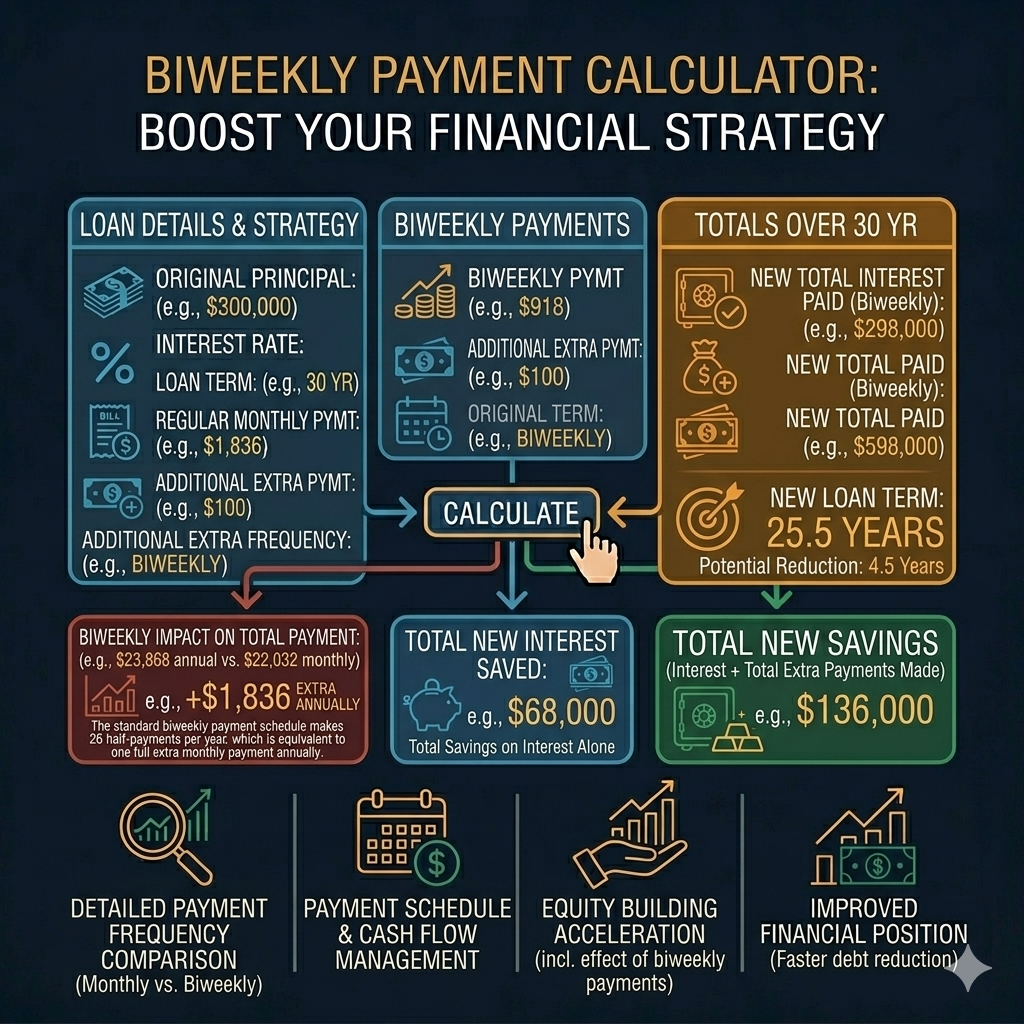
A biweekly mortgage payment plan accelerates your loan amortization by making 26 half-payments per year. On a $400,000 loan at 6.5%, biweekly payments cut over 5 years off your debt and save over $117,000 in interest.
Models two strategies: true biweekly payments processed by your lender, and the free DIY alternative of adding 1/12 of a monthly payment each month. Both result in one extra payment per year. Savings are calculated using exact periodic amortization math.
Biweekly Mortgage Calculator
Chart: remaining balance over time, standard monthly vs biweekly.
How Biweekly Payments Work
A biweekly mortgage payment plan divides your standard monthly principal and interest payment by two, drafting that half-amount every two weeks. Because there are 52 weeks in a calendar year, you make 26 half-payments over 12 months. This equals 13 full monthly payments every year — adding exactly one extra monthly payment directly to your mortgage principal balance annually.
The periodic interest rate for true biweekly schedules is calculated as annual rate / 26. By paying every 14 days, principal balance shrinks earlier in the payment year, compounding your interest reduction over time. For detailed amortizations, visit our full Mortgage Calculator.
True Biweekly vs DIY 1/12 Extra vs Standard Monthly
Many loan servicers charge a setup fee ($300–$500) plus recurring transaction fees to manage an official biweekly program. However, homeowners can replicate nearly 100% of biweekly savings for free using the DIY method: simply divide your monthly principal and interest payment by 12 and add that dollar amount to every monthly payment as extra principal. Learn more about custom extra principal strategies on our Extra Payment Calculator.
Comparison Matrix ($400,000 Loan at 6.5% for 30 Years)
| Strategy | Payment Amount | Paid Per Year | Payoff Time | Total Interest | Interest Saved |
|---|---|---|---|---|---|
| Standard Monthly | $2,528.27 / mo | $30,339 | 30yr 0mo | $510,178 | — |
| True Biweekly | $1,264.14 every 2 wks | $32,868 | 24yr 2mo | $392,682 | $117,496 |
| DIY 1/12 Extra | $2,738.96 / mo ($2,528.27 + $210.69) | $32,868 | 24yr 2mo | $393,836 | $116,342 |
Example: $400,000 at 6.5% for 30 Years
Consider a standard 30-year fixed loan of $400,000 at a 6.50% interest rate. Under standard monthly payments of $2,528.27, total interest paid over 30 years equals $510,178. Switching to a true biweekly payment of $1,264.14 every 14 days drops total interest to $392,682 — saving $117,496 and retiring the mortgage in 24 years and 2 months.
Interest Saved by Loan Size
The total financial return of biweekly payments scales directly with your initial balance and interest rate. Below are baseline projections for standard 30-year fixed mortgages at 6.50%:
| Loan Amount | Monthly P&I | Biweekly Payment | Interest Saved | Time Saved |
|---|---|---|---|---|
| $250,000 | $1,580.17 | $790.08 | $73,435 | 5yr 10mo |
| $300,000 | $1,896.20 | $948.10 | $88,122 | 5yr 10mo |
| $400,000 | $2,528.27 | $1,264.14 | $117,496 | 5yr 10mo |
| $500,000 | $3,160.34 | $1,580.17 | $146,870 | 5yr 10mo |
| $750,000 | $4,740.51 | $2,370.25 | $220,305 | 5yr 10mo |
When Biweekly Payments Are Not Worth It
Biweekly schedules are highly effective, but they are not universally optimal for all borrowers. Consider these key factors before enrolling:
- High-Interest Debt
- If you hold credit card balances or personal loans with interest rates above 10-20%, prioritize clearing high-interest debt before making extra mortgage payments.
- Lack of Emergency Liquidity
- Mortgage equity is illiquid. Money paid into home principal cannot be easily withdrawn without a cash-out refinance or HELOC. Evaluate refinancing options using our Refinance Calculator.
- Third-Party Setup Fees
- Never pay $300-$500 enrollment fees to third-party payment processors. Set up manual extra principal payments directly with your loan servicer instead.
Before You Enroll: Checklist
| Question | Why It Matters |
|---|---|
| Does the servicer apply partial payments immediately? | Many lenders hold partial payments in suspense accounts until a full monthly draft accumulates. |
| Is there an enrollment or per-draft fee? | Third-party fees diminish total interest savings. |
| Is there a prepayment penalty? | Rare on conforming loans, but occasionally present on specialized non-QM products. |
| Do you have a liquid emergency fund? | Maintain 3-6 months of reserves prior to accelerating illiquid mortgage payoff. |
Frequently Asked Questions
How do biweekly mortgage payments actually save money?
You pay half your monthly payment every two weeks. Because there are 52 weeks in a year, you make 26 half-payments — the equivalent of 13 monthly payments instead of 12. That one extra payment goes entirely to principal, which shrinks the balance faster and reduces every interest charge that follows.
How much can biweekly payments save on a $400,000 mortgage?
On a $400,000 loan at 6.5% over 30 years, biweekly payments of about $1,264 typically save roughly $117,000 in interest and retire the loan about 5 years and 10 months early. The exact result depends on your rate, remaining term, and how quickly your servicer applies each payment to principal.
Is a paid biweekly program worth the fee?
Usually not. Enrollment fees of $300 to $500 plus per-draft charges buy you something you can do for free: divide your monthly payment by 12 and add that amount to each payment as extra principal. The savings land within a few months of a true biweekly schedule, and you keep control of the money.
Will my lender apply the extra payment to principal automatically?
Not always. Many servicers hold partial payments in a suspense account until a full monthly payment accumulates, which delays the benefit by weeks. Confirm that your servicer accepts biweekly drafts, applies extra funds to principal immediately, and label every additional amount as "principal only."
Are there downsides to paying biweekly?
Yes. The money becomes home equity, which is illiquid and hard to access without a refinance or HELOC. If you carry credit-card debt near 20% or lack an emergency fund, those come first. A fixed biweekly draft also removes the budget flexibility that voluntary extra payments preserve.
Related Calculators
Explore our full suite of free loan analysis tools:
- Extra Payment Calculator — Calculate one-time, annual, or monthly extra payments.
- Mortgage Calculator — Full principal, interest, taxes, and insurance (PITI) estimator.
- Refinance Calculator — Determine breakeven timing on a rate reduction.
- Affordability Calculator — Calculate maximum home price based on income and DTI ratios.
Sources & Methodology
Calculations adhere to standard monthly and periodic financial compounding principles. Primary industry reference guidelines include:
- Consumer Financial Protection Bureau (CFPB) — Biweekly auto-drafting guidelines and consumer disclosures.
- Fannie Mae Servicing Guide — Rules on principal payment crediting and escrow processing.
- Federal Trade Commission (FTC) — Consumer warnings regarding third-party biweekly program fees.
Last updated: July 2026. All calculations run client-side in your browser. MortiVio stores transient preferences using local browser storage (FormStorage).
Disclaimer
The results shown by this calculator are estimates for educational purposes only and are not a loan offer, a pre-approval, or financial advice. Actual payments depend on your lender, credit profile, property location, taxes, insurance, HOA dues, and loan program rules, and may differ from the figures shown here. Rates change daily. Consult a licensed mortgage professional before making a decision.
Last updated: .