Construction Loan Calculator
On a $600,000 project with a 10-month build at 8.08%, a typical five-stage draw schedule accrues about $15,150 in construction interest — far less than the $30,300 a fully drawn loan would cost. Model your month-by-month draw schedule, interest costs, and permanent mortgage conversion in one view.
Models the two-phase cost of building a home: interest-only payments during the 12–18 month construction phase, then the permanent mortgage. Draw schedule follows a 5 stage disbursement model. Permanent loan limits follow current FHFA conforming figures.
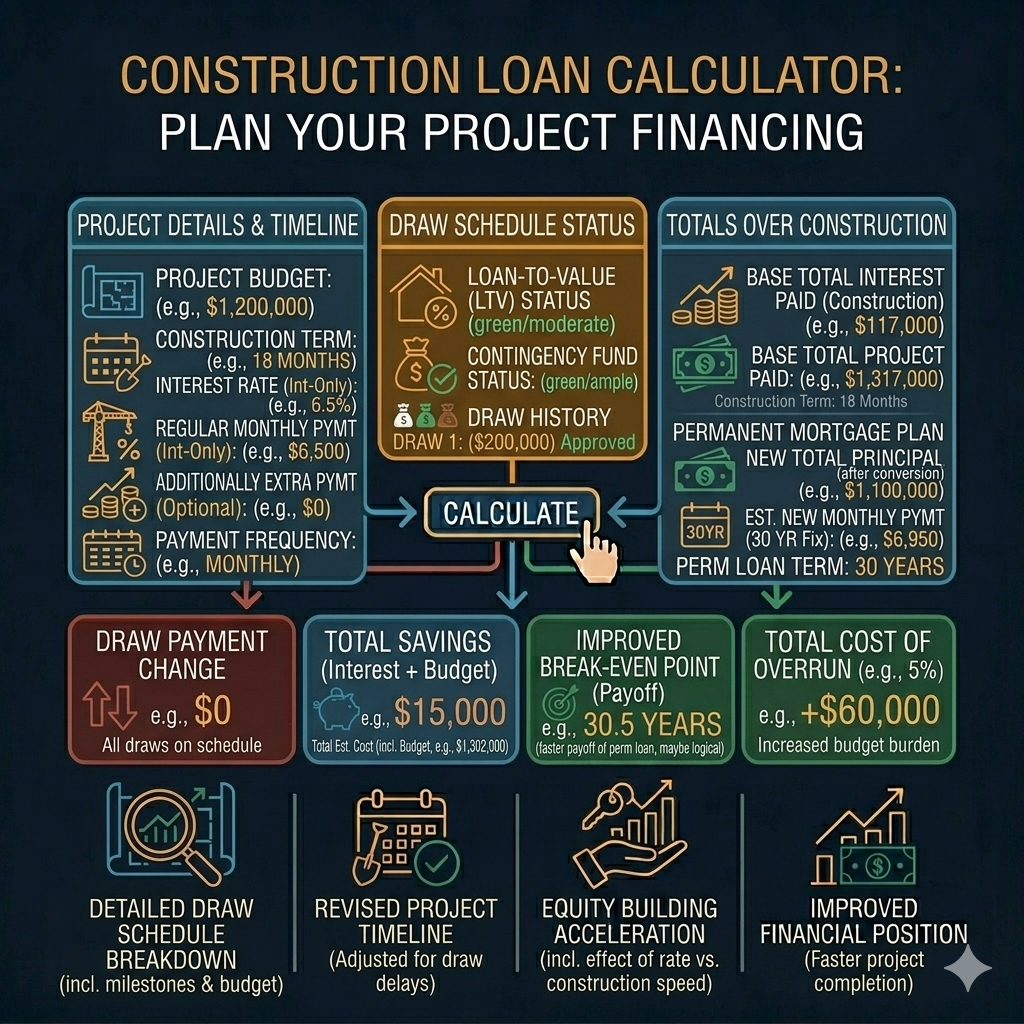
Construction Loan Calculator
Project Details
Permanent Loan
Insurance & Fees
Your Results
Construction Timeline
How Construction Loan Interest Works
A construction loan is a short-term, interest-only loan that releases funds in stages called draws as the build progresses, then converts to or is replaced by a permanent mortgage at completion. Unlike a traditional purchase loan where you owe interest on the full amount from day one, construction interest accrues only on the cumulative drawn balance each month.
Monthly Construction Interest = Outstanding Drawn Balance × (Annual Construction Rate / 12)
Because your drawn balance starts small (e.g., foundation draw only) and grows as framing, mechanicals, and finishes are finished, your monthly interest payments ramp up over the build period.
The Five-Stage Draw Schedule
Lenders disburse funds in defined stages after an independent inspector verifies that specific milestones are complete. Below is the month-by-month draw simulation for a baseline $600,000 project ($450,000 loan at 8.08% over 10 months):
| Stage Name | Disbursement Month | Draw % | Draw Amount | Outstanding Drawn Balance | Monthly Interest |
|---|---|---|---|---|---|
| 1. Foundation & Site Work | Month 2 | 15% | $67,500 | $67,500 | $454 / mo |
| 2. Framing & Exterior Shell | Month 4 | 25% | $112,500 | $180,000 | $1,212 / mo |
| 3. Mechanicals (MEP & Roof) | Month 6 | 20% | $90,000 | $270,000 | $1,818 / mo |
| 4. Interior Finishes & Drywall | Month 8 | 25% | $112,500 | $382,500 | $2,576 / mo |
| 5. Final Completion & Sign-off | Month 10 | 15% | $67,500 | $450,000 | $3,030 / mo |
| Total Construction Phase | 10 Months | 100% | $450,000 | — | ~$15,150 Total |
A fully drawn $450,000 loan at 8.08% for 10 months would cost $30,300. The staged draw schedule reduces total interest to roughly $15,150 — saving about $15,150 during construction.
Construction Loan vs Permanent Mortgage
Understanding the key differences between financing phases is essential for project budgeting:
| Feature | Construction Phase | Permanent Mortgage |
|---|---|---|
| Payment Structure | Interest-only on drawn balance | Fully amortizing principal & interest |
| Interest Rate | Typically 1.0%–1.5% above market | Standard fixed conforming rate |
| Term Length | 6 to 18 months short-term | 15 or 30 years long-term |
| Disbursement Method | Staged draw releases upon inspection | Lump-sum payoff of construction loan |
| Down Payment / Equity | 20%–25% of total project value | Equity carried over from build phase |
| Inspections | 1 inspection required per draw ($150–$500) | None (standard annual servicing) |
Total Project Cost Breakdown
Building a home involves hard construction costs, soft design fees, land acquisition, and financing expenses:
| Budget Category | What It Includes | Typical Share of Total |
|---|---|---|
| Land Acquisition | Lot purchase or existing land equity | 15% – 25% |
| Hard Costs | Materials, labor, foundation, framing, finishes | 60% – 75% |
| Soft Costs | Permits, architectural plans, surveys, engineering | 5% – 12% |
| Financing Costs | Construction interest, draw inspections, builder's risk insurance | 3% – 6% |
| Contingency Reserve | Documented reserve for unexpected price overruns | 10% – 15% |
Note: Construction projects commonly exceed original estimates. Industry standard practice recommends a documented contingency reserve of 10% to 15% before approving the loan. This calculator adds your contingency percentage to both Total Project Cost and Out-of-Pocket Cash Required, but excludes it from the appraised value used for loan-to-value, because an unspent reserve is not collateral.
Build Duration Impact on Total Interest
| Build Duration | Total Construction Interest Accrued | Average Monthly Interest |
|---|---|---|
| 6 Months (Fast Track) | $10,302 | $1,717 / mo |
| 10 Months (Standard Build) | $15,150 | $1,515 / mo |
| 14 Months (Delayed Build) | $19,998 | $1,428 / mo |
| 18 Months (Complex Custom Build) | $24,998 | $1,389 / mo |
Construction-to-Permanent vs Two-Close Loans
A construction-to-permanent loan (single close) combines the build loan and permanent mortgage into one contract. You pay closing costs once. A two-close loan uses separate construction and permanent loans, requiring two closings and double the closing fees. Single-close loans reduce transaction friction and lock in permanent rates earlier.
Frequently Asked Questions
How is interest calculated on a construction loan?
Interest accrues only on the amount actually drawn, not on the full approved loan. Each month the lender charges the construction rate on the outstanding drawn balance, so the cost starts small and grows as the build progresses. This calculator simulates every month of the draw schedule rather than using an average-balance shortcut.
What is a typical construction draw schedule?
A common five-stage schedule releases roughly 15% at foundation, 25% at framing, 20% at mechanicals and roofing, 25% at interior finishes and 15% at completion. Each draw requires an inspection before funds are released, and lenders usually hold back 5% to 10% as retainage until final sign-off.
How much down payment does a construction loan require?
Most lenders require 20% to 25% of total project cost, and land you already own free and clear can count toward that equity. Requirements are stricter than for a purchase mortgage because there is no finished collateral until the build is complete. Rates also run about 1 to 1.5 points higher.
What is a construction-to-permanent loan?
It is a single loan that funds the build with interest-only payments and then converts to a standard amortizing mortgage at completion, with one closing and one set of closing costs. A two-close structure uses a separate construction loan and a separate permanent mortgage, meaning you pay closing costs twice.
How much do inspections and draw fees add to the budget?
Expect $150 to $500 per inspection, with one inspection per draw, plus a draw administration fee at some lenders. Over a five-draw build that is typically $750 to $2,500. These are financing costs and belong in your project budget, not in the builder's contract price.
Related Calculators
Explore our related financing tools:
- Mortgage Calculator — Estimate your permanent amortizing PITI payment.
- Affordability Calculator — Check qualifying budget limits based on income.
- Loan Comparison Tool — Compare side-by-side permanent loan terms.
Sources & Methodology
Construction underwriting references standard industry guidelines:
- Fannie Mae Single Family Selling Guide (B5-3.1) — Construction-to-permanent financing rules.
- CFPB Construction Loan Guidelines — Draw disclosures and closing requirements.
- FHFA Conforming Loan Limits (2026) — National conforming loan thresholds.
Last updated: July 2026. All calculations run client-side in your browser. MortiVio stores transient preferences using local browser storage (FormStorage).
Disclaimer
This calculator provides estimates for educational and budgeting purposes only and is not financial, tax, or legal advice. Draw schedules, inspection fees, retainage, insurance costs, and interest rates vary by lender, builder, state, and project. Actual construction interest depends on when funds are drawn. Confirm all figures with your lender and builder before committing.
Last updated: .