Refinance Calculator
This refinance calculator shows whether a new loan actually saves money. Enter your current balance, rate, remaining term and payment, then the new rate, term and closing costs. It returns your monthly savings, the break-even month and a same-horizon comparison so a longer term cannot hide extra interest.
Calculates break even point, monthly savings, and lifetime interest delta between your current loan and a new rate. New rate defaults are pulled from Freddie Mac's PMMS weekly average, updated every Thursday. Closing cost estimates based on national average data from the Consumer Financial Protection Bureau.
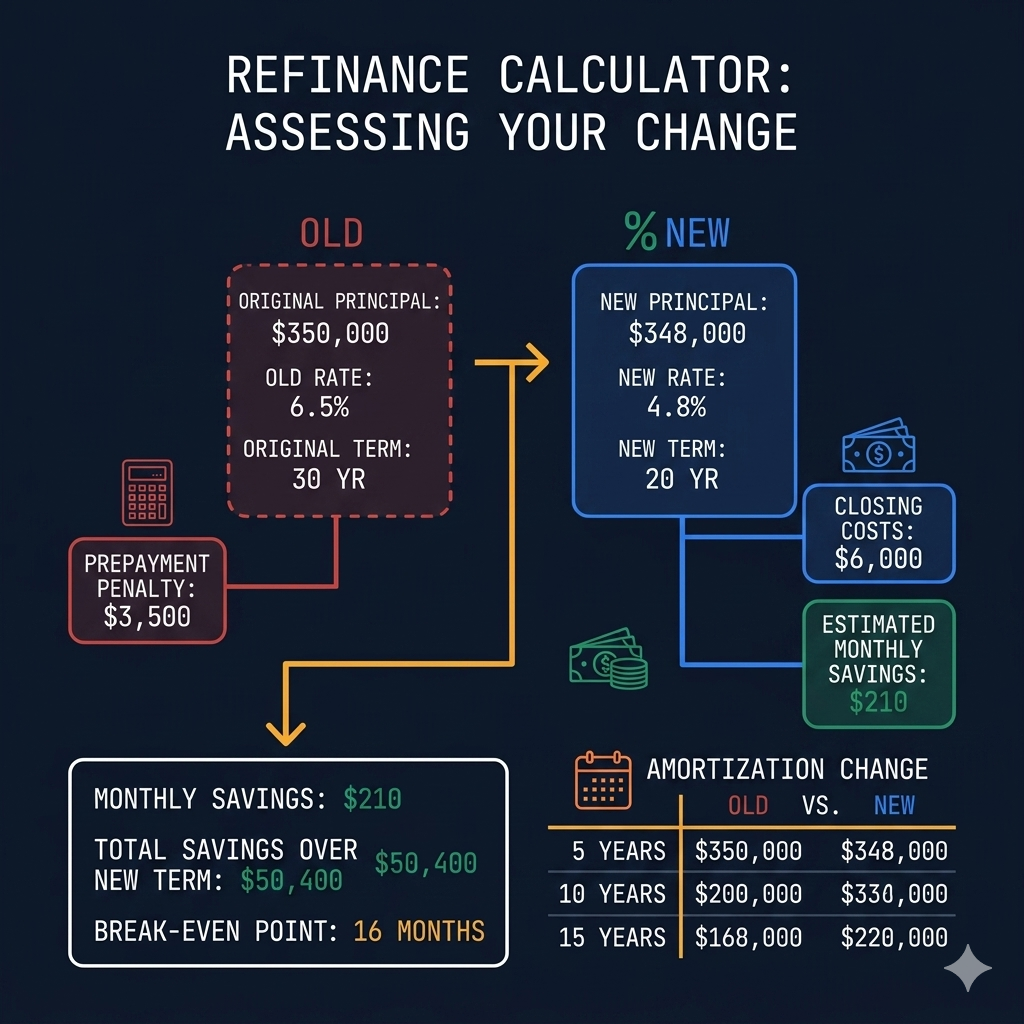
Refinance Calculator
Current Loan
New Loan
How This Refinance Calculator Works
This refinance calculator evaluates whether replacing your existing mortgage with a new rate and term yields net financial savings. Rather than simply comparing 30-year totals against remaining 25-year balances, MortiVio evaluates both loans over the identical time horizon so extending your term cannot mask long-term interest costs.
Break-Even Point: The Number That Decides It
Your break-even month represents how long you must remain in the home for monthly payment savings to offset your upfront closing costs:
Break-Even Months = (Total Upfront Closing Costs + Prepayment Penalty) / Monthly Savings
If closing costs total $5,000 and refinancing saves $231.45 per month, your break-even point occurs at month 22 (~1 year 10 months). If you sell or refinance again before month 22, the transaction loses money.
Why a Lower Payment Can Still Cost You More
Replacing 25 remaining years with a new 30-year mortgage drops your required monthly payment, but adds 60 extra months of interest charges. In the example below, refinancing a $280,000 balance into a 30-year term drops the monthly P&I by $231, but increases total lifetime interest by over $26,000 due to term extension.
Closing Costs and Prepayment Penalties
Refinance closing costs typically range between 2% and 5% of the new loan amount. Prepayment penalties are rare on conforming loans but exist on certain specialized non-QM products.
Example Scenarios
Example: A $280,000 balance at 7.25% with 25 years remaining ($2,016/mo P&I) refinanced into a 30-year loan at 6.58% ($1,785/mo P&I). Monthly savings equal $231. With $5,000 in closing costs, break-even is 22 months. Over the same 25-year horizon, the new loan leaves an un-amortized balance, resulting in a net cost of $26,596.
Break-Even Matrix by Closing Cost and Monthly Savings
| Monthly Savings | $3,000 Closing Costs | $5,000 Closing Costs | $8,000 Closing Costs |
|---|---|---|---|
| $100 / mo | 30 months (2.5 yrs) | 50 months (4.2 yrs) | 80 months (6.7 yrs) |
| $200 / mo | 15 months (1.3 yrs) | 25 months (2.1 yrs) | 40 months (3.3 yrs) |
| $231 / mo (base) | 13 months (1.1 yrs) | 22 months (1.8 yrs) | 35 months (2.9 yrs) |
| $300 / mo | 10 months (0.8 yrs) | 17 months (1.4 yrs) | 27 months (2.3 yrs) |
| $400 / mo | 8 months (0.7 yrs) | 13 months (1.1 yrs) | 20 months (1.7 yrs) |
Same-Horizon Comparison ($280,000 Balance, 25-Year Horizon)
| Metric | Keep Current Loan (7.25%, 25 yr) | Refinance to New (6.58%, 30 yr) |
|---|---|---|
| Monthly P&I Payment | $2,016.00 / mo | $1,784.55 / mo |
| Payments Paid Over Next 25 Years | $604,800 | $535,365 |
| Remaining Balance Owed at Year 25 | $0 (Loan paid off) | $91,031 (Owed on 30-yr loan) |
| Upfront Closing Costs | $0 | $5,000 |
| Net Cost Over 25 Years | $604,800 | $631,396 |
| Same-Horizon Net Savings | Base | -$26,596 (Costs More) |
Typical Refinance Closing Costs Breakdown
| Fee Item | Typical Cost Range | Notes |
|---|---|---|
| Home Appraisal | $400 – $700 | Required to verify current property market value. |
| Title Insurance & Search | $1,000 – $2,000 | Lender's title policy for the new mortgage. |
| Lender Origination Fee | 0.5% – 1.0% of loan | Covers underwriting and processing. |
| Credit Report & Recording Fees | $150 – $350 | County recording and credit check charges. |
Assumptions and Limitations
- Calculations assume fixed-rate principal and interest payments only. Property taxes, insurance, and escrow reserves are excluded from break-even math.
- If tax deductibility applies to your mortgage interest, consult a certified tax professional regarding net after-tax savings.
Frequently Asked Questions
How do I calculate my refinance break-even point?
Divide your total upfront cost by your monthly savings. If closing costs are $5,000, there is no prepayment penalty, and the new loan lowers your payment by $250 per month, the break-even point is 5,000 / 250 = 20 months. If you expect to sell or refinance again before that date, the refinance loses money. If monthly savings are zero or negative, there is no break-even point at all.
Is it worth refinancing for a 1% lower rate?
Often yes on a large balance, but the rate drop alone does not decide it. What matters is the break-even point and how long you will keep the loan. A 1 percentage point drop on a $280,000 balance saves roughly $180 to $200 per month, which recovers $5,000 of closing costs in about 26 months. On a $120,000 balance the same drop takes far longer to pay back.
Does refinancing restart my loan term?
Yes, unless you choose a shorter term. Replacing 25 remaining years with a new 30-year loan adds five years of payments, which can raise total interest even though the monthly payment falls. To avoid this, either refinance into a term that matches your remaining years or keep paying the old payment amount on the new loan so the difference goes to principal.
What are typical refinance closing costs?
Refinance closing costs generally run about 2% to 5% of the loan amount and commonly include an appraisal of around $500, title insurance of around $1,400, an origination fee often near 1% of the loan, plus recording and credit report fees. A "no-cost" refinance does not remove these costs; it rolls them into the balance or pays for them with a higher rate.
Will refinancing hurt my credit score?
The hard inquiry and the new account typically lower a score by a few points for several months. Mortgage rate shopping within a short window, usually 14 to 45 days depending on the scoring model, is treated as a single inquiry, so comparing several lenders does not multiply the impact. Continuing to pay on time restores the score quickly.
Related Calculators
Explore our full suite of refinancing decision tools:
- Mortgage Calculator — Estimate full baseline PITI payments.
- Loan Comparison Tool — Compare side-by-side loan quotes with points.
- Extra Payment Calculator — Test prepaying vs refinancing.
- DTI Calculator — Check qualifying DTI for a new loan.
Sources & Methodology
Refinancing benchmarks reference official Federal Reserve and CFPB standards:
- CFPB Refinance Guide — Closing cost disclosure rules and loan estimate standards.
- Freddie Mac Primary Mortgage Market Survey (PMMS) — National benchmark interest rates.
Last updated: July 2026. All calculations run client-side in your browser. MortiVio stores transient preferences using local browser storage (FormStorage).
Disclaimer
The results shown by this calculator are estimates for educational purposes only and are not a loan offer, a pre-approval, or financial advice. Actual payments depend on your lender, credit profile, property location, taxes, insurance, HOA dues, and loan program rules, and may differ from the figures shown here. Rates change daily. Consult a licensed mortgage professional before making a decision.
Last updated: .