Debt-to-Income (DTI) Calculator
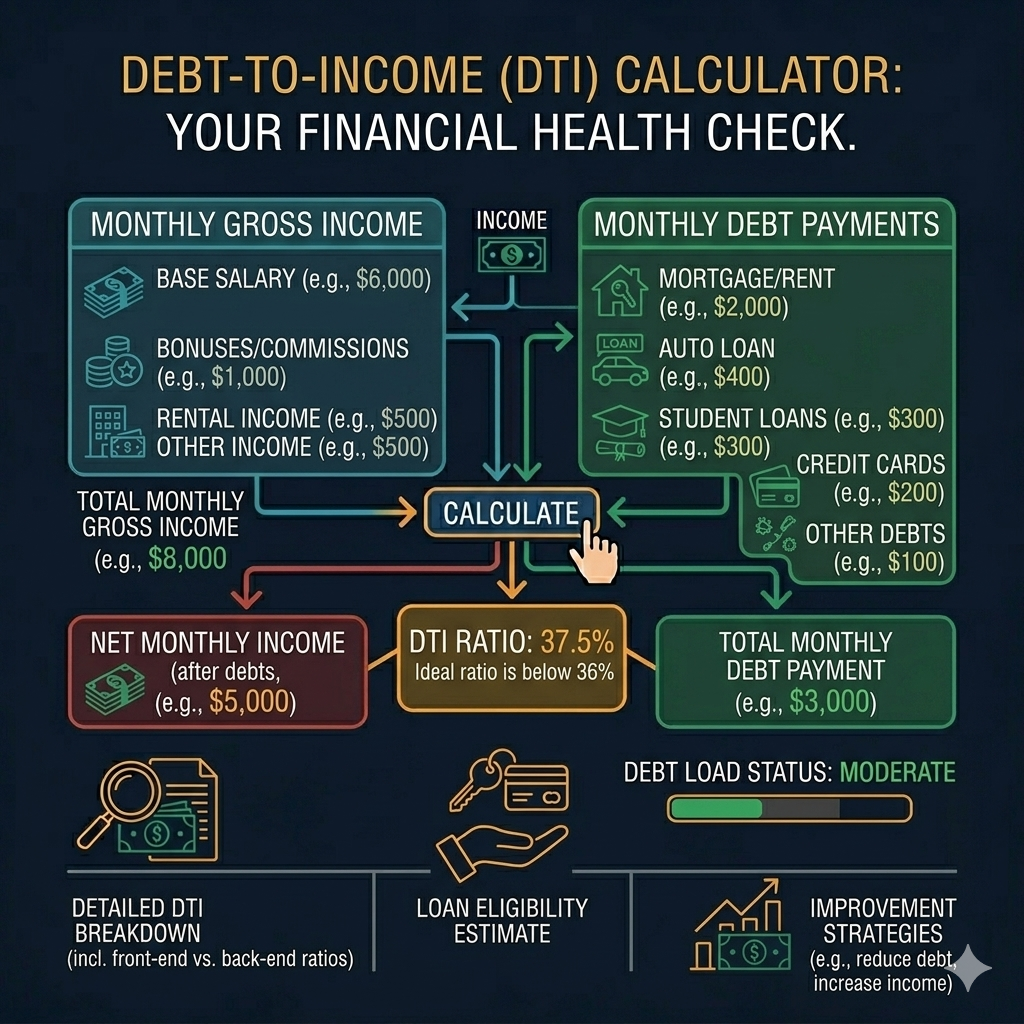
Debt-to-income ratio (DTI) is the share of your gross monthly income that goes to required monthly debt payments, expressed as a percentage. Calculate front-end and back-end DTI for Conventional, FHA, VA, and USDA loans with student loan IDR rules.
Calculates front-end and back-end DTI ratios and shows how they map to loan approval thresholds. Limits are sourced from Fannie Mae's Selling Guide and updated per FHA, VA, and USDA underwriting standards. Student loan treatment follows current income-driven repayment (IDR) rules.
DTI Calculator
Income
Housing Payment
Monthly Debts
Program Qualification Breakdown
Conventional ⚠ Front Over
FHA ✓ PASS
VA ✗ OVER
USDA ✗ OVER
PASS means your ratio is within the program guideline. It is not a loan approval — credit score, reserves, employment history and lender overlays also determine eligibility.
How Debt-to-Income Ratio Is Calculated
Your debt-to-income ratio compares your total monthly debt payments against your gross monthly income (before taxes and deductions). Mortgage underwriters use two primary DTI formulas to evaluate your borrowing capacity:
Front-End DTI = (Total Housing Payment / Gross Monthly Income) × 100
Back-End DTI = (Total Housing Payment + All Recurring Debts) / Gross Monthly Income × 100
For example, with an annual income of $95,000 ($7,916.67 per month), a proposed housing payment of $2,400 yields a front-end DTI of 30.3%. Adding $880 in monthly auto, student loan, and credit card payments brings total monthly obligations to $3,280 — resulting in a back-end DTI of 41.4%.
Front-End vs Back-End DTI
The front-end ratio (housing ratio) includes only your principal, interest, property taxes, homeowners insurance, HOA fees, and PMI. The back-end ratio includes housing costs plus all minimum monthly recurring consumer debt payments.
Lenders weight the back-end ratio most heavily during automated underwriting. To model how changing your home purchase price affects your housing ratio, use our Affordability Calculator.
DTI Limits by Loan Program
Each major U.S. mortgage program establishes specific front-end and back-end DTI guidelines:
| Program | Front-End Guideline | Back-End Guideline | Automated Underwriting (AUS) Max | Primary Source |
|---|---|---|---|---|
| Conventional | 28% | 36% | 45% (50% with strong compensating factors) | Fannie Mae Selling Guide B3-6-02 |
| FHA | 31% | 43% | 50%+ with TOTAL Scorecard approval | HUD Handbook 4000.1 |
| VA | Not used | 41% soft threshold | Residual income test governs approval | VA Lenders Handbook M26-7 Ch.4 |
| USDA | 29% | 41% manual | 46% with Guaranteed Underwriting System (GUS) | USDA HB-1-3555 Ch.11 |
What Counts as Debt (and What Does Not)
Understanding which expenses enter your DTI calculation prevents unexpected qualification surprises:
| Counted in DTI Calculation | Excluded from DTI Calculation |
|---|---|
| Auto loan and lease payments | Utilities (electricity, water, gas, trash) |
| Student loan payments (or agency benchmark) | Groceries, dining, and household spending |
| Credit card minimum required payments | Cell phone and internet service plans |
| Personal and installment loans | Health, auto, and life insurance premiums |
| Other mortgage or real estate liabilities | 401(k) or 403(b) retirement loan repayments |
| Court-ordered alimony and child support | Streaming services and digital subscriptions |
How Student Loans Are Counted
Student loans on Income-Driven Repayment (IDR/IBR/SAVE) plans receive varying treatment across loan programs:
| Program | Accepts Documented IDR Payment | Rule If Documented Payment Is $0 | Primary Guideline Source |
|---|---|---|---|
| Conventional | Yes, including $0 when documented | Use documented $0 payment | Fannie Mae B3-6-05 / Freddie Mac 5401.2 |
| FHA | Yes | Use 0.5% of total balance per month | HUD Handbook 4000.1 |
| VA | Yes | Use 5% of balance / 12 if no payment documented | VA M26-7 Ch.4 |
| USDA | Yes | Use 0.5% of total balance per month | USDA HB-1-3555 Ch.11 |
Example: How One Debt Changes Your DTI
The table below demonstrates how adding consumer debts affects DTI on a $95,000 annual income ($7,917/mo) with a $2,400 monthly housing payment:
| Scenario | Monthly Non-Housing Debts | Back-End DTI | Conventional Status | FHA Status |
|---|---|---|---|---|
| Housing payment only | $0 | 30.3% | ✓ PASS | ✓ PASS |
| + Car loan ($450) | $450 | 36.0% | ✓ PASS | ✓ PASS |
| + Student loan ($280) | $730 | 39.5% | ✓ PASS | ✓ PASS |
| + Credit cards ($150) | $880 | 41.4% | ✓ PASS | ✓ PASS |
| + Extra loan ($400) | $1,280 | 46.5% | ✗ OVER (exceeds 45%) | ✓ PASS (under 50%) |
How to Lower Your DTI Before Applying
- Pay Off Small Installment Debts: Completely paying off a car loan with 4 payments remaining removes the entire $450 monthly obligation from your DTI.
- Consolidate Credit Card Balances: Lower your monthly minimum payments by reducing high-interest credit card debt. See how extra payments accelerate payoff on our Extra Payment Calculator.
- Include Co-Borrower Income: Adding a co-borrower whose gross income exceeds their personal debt obligations lowers your combined DTI ratio.
- Rebalance Housing Budget: Adjust your target purchase price to lower your monthly P&I payment using our Mortgage Calculator.
Frequently Asked Questions
What is a good debt-to-income ratio?
A back-end DTI at or below 36% is considered strong and gives you the widest choice of lenders and pricing. Most conventional loans remain approvable up to 45% through automated underwriting, and FHA can reach 50% or higher with compensating factors such as cash reserves or a high credit score.
What is the difference between front-end and back-end DTI?
Front-end DTI counts only your housing payment — principal, interest, taxes, insurance, HOA dues and mortgage insurance — divided by gross monthly income. Back-end DTI adds every other required monthly debt payment. Lenders weight the back-end ratio most heavily, but several programs publish limits on both.
Which debts are included in a DTI calculation?
Monthly payments on auto loans and leases, student loans, credit cards at the minimum due, personal loans, other mortgages, alimony and child support. Utilities, groceries, cell phone bills, insurance premiums and 401(k) loan repayments are excluded. Income is measured gross, before taxes.
How are student loans on income-driven repayment counted?
It depends on the program. FHA uses 0.5% of the outstanding balance when the documented payment is zero. Conventional loans generally accept the actual documented IDR payment, including $0, when it appears on the credit report or in servicer documentation. Confirm current agency guidance with your lender.
How can I lower my DTI before applying for a mortgage?
Pay off small installment loans entirely — eliminating a $450 car payment helps more than paying the same amount toward a credit card balance. Avoid opening new credit, document all qualifying income including bonuses and self-employment, and consider a co-borrower whose income exceeds their debts.
Related Calculators
Explore our other mortgage planning tools:
- Affordability Calculator — Determine maximum purchasing price based on income and DTI.
- Mortgage Calculator — Estimate full monthly PITI payments.
- Extra Payment Calculator — Calculate debt payoff acceleration strategies.
Sources & Methodology
Underwriting guidelines strictly reference official government agency manuals:
- Fannie Mae Selling Guide B3-6-02 & B3-6-05 — DTI limits & student loan rules.
- HUD FHA Single Family Housing Policy Handbook 4000.1 — FHA TOTAL Scorecard standards.
- VA Lenders Handbook M26-7 Chapter 4 — Residual income underwriting requirements.
- USDA Rural Development HB-1-3555 Chapter 11 — GUS underwriting guidelines.
Last updated: July 2026. All calculations run client-side in your browser. MortiVio stores transient preferences using local browser storage (FormStorage). No income or debt information is transmitted to external servers.
Disclaimer
This calculator provides estimates for educational and planning purposes only and is not financial, tax, or legal advice. DTI guidelines change and individual lenders apply their own overlays. Results do not constitute a pre-qualification or loan approval. Confirm all figures with a licensed mortgage professional before making a financial decision.
Last updated: .