Extra Payment Calculator
Every extra dollar paid toward your mortgage principal directly reduces your balance, avoiding all future interest that dollar would have accumulated. On a $300,000 loan at 6.58%, adding $200 a month saves over $105,000 in interest and retires your debt 7 years early.
Shows exactly how many months an extra payment shaves off your mortgage and how much interest you avoid. Recalculates the full amortization schedule in real time using the standard PMT formula — no estimates, no rounding tricks. Works for one-time lump sums, monthly additions, or annual overpayments.
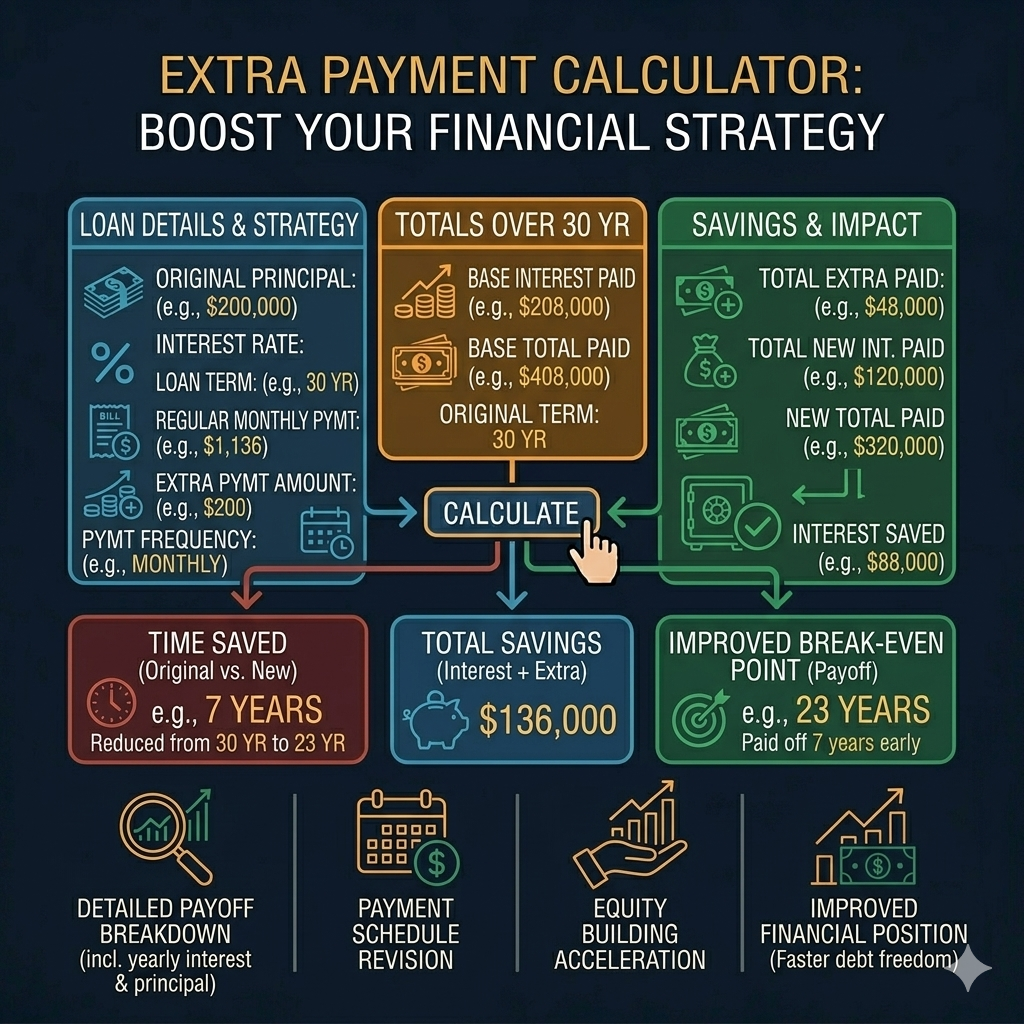
Extra Payment Calculator
Loan Details
Extra Payments
The one-time payment is applied in month 1. The annual extra payment is applied in month 12 of each year.
Chart: remaining mortgage balance over time (Original vs With Extra Payments).
How Extra Payments Shorten Your Loan
Mortgage interest is calculated monthly against your outstanding principal balance. When you make an extra payment specifically designated for principal, you immediately lower the balance on which future interest is assessed. Every extra dollar paid avoids compounded interest for the remaining lifespan of the mortgage.
Why Timing Matters More Than Amount
Because mortgage interest is heavily front-loaded in standard amortization schedules, extra payments made during the first 5 to 10 years of a loan generate vastly greater interest savings than the same payments made near loan maturity.
Monthly vs Annual vs One-Time
Making a recurring monthly extra payment accelerates balance reduction continuously. Annual lump sums (such as tax refunds or bonuses) achieve nearly identical long-term savings. One-time principal payments made early in the loan term produce immediate structural interest reduction.
Example Scenarios
The table below shows the impact of adding monthly extra principal payments to a baseline $400,000 30-year fixed loan at 6.50% ($2,528.27 scheduled monthly P&I):
| Extra Monthly Payment | New Total Payment | Payoff Time | Time Saved | Total Interest Paid | Total Interest Saved |
|---|---|---|---|---|---|
| $0 / mo | $2,528.27 | 30yr 0mo | — | $510,178 | — |
| +$100 / mo | $2,628.27 | 26yr 7mo | 3yr 5mo | $439,812 | $70,366 |
| +$200 / mo | $2,728.27 | 24yr 0mo | 6yr 0mo | $385,820 | $124,358 |
| +$500 / mo | $3,028.27 | 18yr 8mo | 11yr 4mo | $279,340 | $230,838 |
| +$1,000 / mo | $3,528.27 | 13yr 7mo | 16yr 5mo | $189,450 | $320,728 |
Lump Sum Timing Comparison ($24,000 Total Extra Paid)
| Strategy | Total Extra Capital | Payoff Term | Total Interest Saved |
|---|---|---|---|
| $24,000 Lump Sum in Month 1 | $24,000 | 25yr 2mo | $108,420 Saved |
| $100 / month for 20 years ($24,000 total) | $24,000 | 26yr 7mo | $70,366 Saved |
Recasting vs Prepaying vs Refinancing
Homeowners seeking to lower housing costs often compare prepaying principal against recasting or refinancing:
- Prepaying Principal
- Adding funds to your regular monthly draft. Shortens your loan term while your required monthly P&I payment remains unchanged.
- Loan Recasting
- Making a large lump-sum principal payment ($10,000+) and asking your servicer to re-amortize the remaining balance over the remaining term. This lowers your required monthly payment without changing your interest rate.
- Refinancing
- Replacing your existing mortgage with a brand new loan contract at a lower interest rate or shorter term. Evaluate rate reduction breakeven points using our Refinance Calculator.
- Biweekly Acceleration
- Drafting half your payment every 2 weeks to execute 13 full monthly payments per year. Model this strategy on our Biweekly Payment Calculator.
When Extra Payments Are Not the Best Use of Cash
Accelerating your mortgage payoff is an illiquid investment. Consider these financial priorities before prepaying:
- High-Interest Consumer Debt: Credit card balances carrying 18%–25% interest take strict priority over a 6%–7% mortgage.
- Emergency Cash Reserves: Maintain 3–6 months of liquid emergency funds in accessible high-yield savings before locking cash into home equity.
- Employer 401(k) Match: Never sacrifice a 100% employer match on retirement contributions to prepay a mortgage.
How to Make Sure the Payment Goes to Principal
Lenders do not automatically apply extra funds toward principal. When submitting extra payments:
- Specify the extra amount clearly as "Principal Only" on physical checks or digital payment portals.
- Confirm your servicer does not hold the funds in a "suspense account" to cover future regular monthly installments.
- Verify on your subsequent monthly mortgage statement that your principal balance declined by the exact extra amount paid.
Frequently Asked Questions
How much can extra mortgage payments save me?
Extra payments reduce principal immediately, so every dollar avoids all the future interest that dollar would have generated. On a $400,000 loan at 6.50% over 30 years, adding $200 a month can save roughly $100,000 in interest and shorten the payoff by about 6 years in this example. The earlier the extra payment is made, the larger the effect.
Is it better to pay extra monthly or once a year?
Paying extra every month saves slightly more than paying the same total once a year, because the balance is reduced sooner and less interest accrues. The difference is usually small, often a few thousand dollars over the life of a large loan, so consistency matters more than timing. Choose whichever schedule you can maintain without draining your emergency fund.
Do extra payments lower my monthly payment?
No, extra payments shorten the loan term rather than reduce the required monthly payment. Your scheduled payment stays the same, but you reach a zero balance earlier. If you want a lower monthly payment after paying a large lump sum, ask your servicer about a loan recast, which re-amortizes the remaining balance over the original term, usually for a small fee.
Will my lender charge a prepayment penalty?
Most conforming mortgages originated today do not carry prepayment penalties, but some non-qualified and investor loans still do. Check your note or closing disclosure for a prepayment section before making large extra payments, and confirm that the money is applied to principal rather than held as a prepaid future installment.
When are extra mortgage payments not the best use of money?
Paying extra on a mortgage is rarely the best move when you still carry higher-interest debt, lack an emergency fund, or are missing an employer retirement match. A 6.50% mortgage costs less than typical credit card interest, and mortgage interest may be deductible for some filers. Extra payments also lock money into home equity that is not easy to access quickly.
Related Calculators
Explore our other mortgage optimization tools:
- Biweekly Payment Calculator — Replicate 13 payments per year with biweekly auto-drafting.
- Mortgage Calculator — Full baseline PITI amortization schedule.
- Refinance Calculator — Compare prepaying vs refinancing to a lower rate.
Sources & Methodology
Amortization algorithms adhere strictly to CFPB prepayment regulations. References include:
- Consumer Financial Protection Bureau (CFPB) — Mortgage prepayment rules and servicer requirements.
- Fannie Mae Servicing Guide — Principal curtailment crediting guidelines.
Last updated: July 2026. All calculations run client-side in your browser. MortiVio stores transient preferences using local browser storage (FormStorage).
Disclaimer
The results shown by this calculator are estimates for educational purposes only and are not a loan offer, a pre-approval, or financial advice. Actual payments depend on your lender, credit profile, property location, taxes, insurance, HOA dues, and loan program rules, and may differ from the figures shown here. Rates change daily. Consult a licensed mortgage professional before making a decision.
Last updated: .