How Much House Can I Afford?
With $85,000 of gross annual income, $500 of monthly debt, and 20% down at 6.58%, a conventional borrower can afford a maximum home price near $289,000. MortiVio evaluates both front-end (28%) and back-end (45%) DTI limits to find your true qualifying ceiling.
Finds your maximum home price using income, debts, and down payment. DTI thresholds follow Fannie Mae Selling Guide limits, 28% front end, 45% back end for conventional. FHA, VA, and USDA limits are modeled separately.
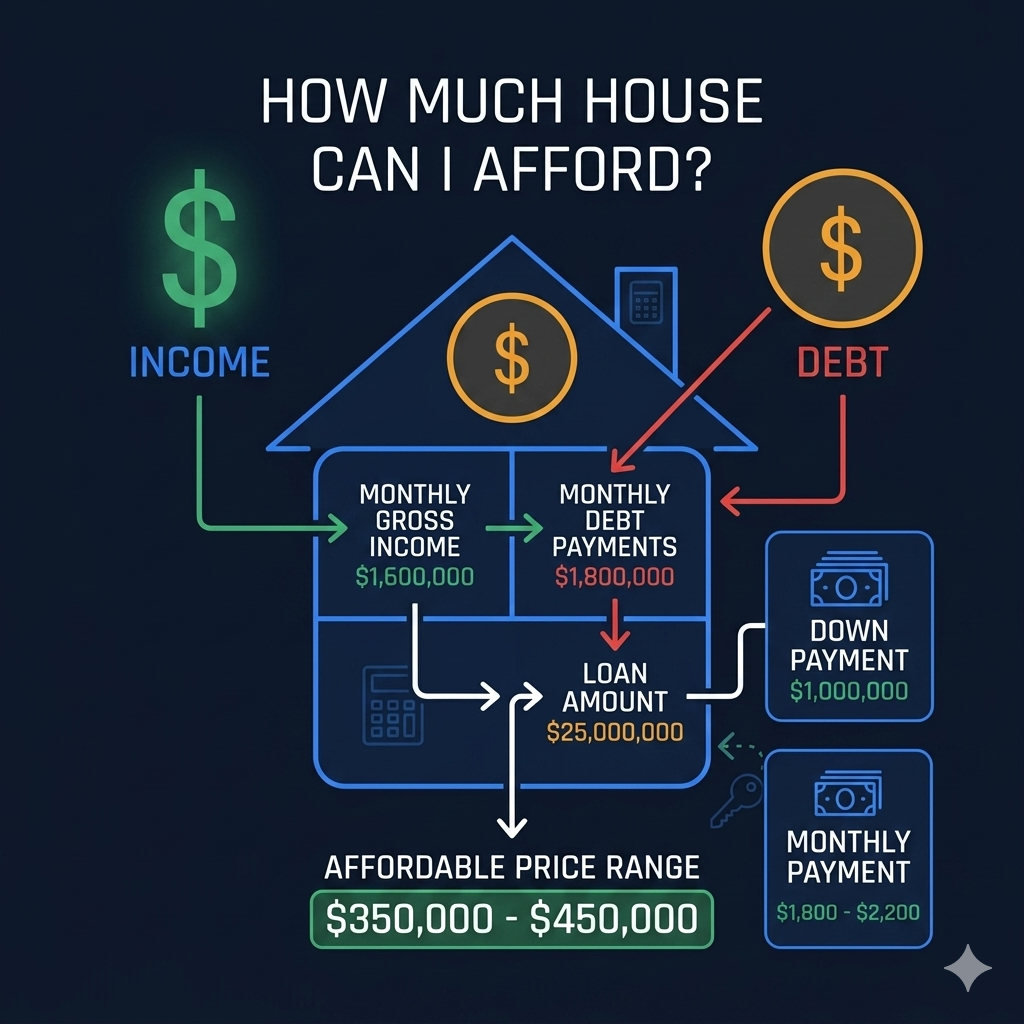
How Much House Can I Afford?
Your Financial Profile
These figures represent the maximum ceiling allowed by lender DTI limits. Actual loan approval depends on credit score, financial reserves, employment history, and property appraisal.
How Lenders Decide What You Can Afford
Mortgage underwriting relies heavily on your Debt-to-Income (DTI) ratio, which measures the percentage of your gross pre-tax monthly income devoted to debt obligations. Lenders evaluate two distinct DTI thresholds:
Front-End Ratio (Housing)
The front-end DTI measures total recurring housing expenses (PITI: Principal, Interest, Property Tax, Insurance, PMI, and HOA dues) relative to gross monthly income. A 28% front-end limit means your complete monthly housing bill cannot exceed $2,800 on a $10,000 monthly income.
Back-End Ratio (Total Debt)
The back-end DTI measures your total monthly housing payment plus all recurring personal obligations (car loans, student loans, minimum credit card payments, child support). Conventional Fannie Mae limits generally cap back-end DTI at 45%.
The 28/36 Rule and Where It Comes From
The traditional 28/36 rule recommended keeping housing at or below 28% and total debt at or below 36%. While modern automated underwriting systems (such as Fannie Mae Desktop Underwriter) allow higher back-end caps with strong credit, staying near 28/36 provides a healthy financial buffer for unexpected living costs.
DTI Limits by Loan Program
Underwriting guidelines vary significantly across mortgage programs:
| Loan Program | Front-End (Housing) Limit | Back-End (Total Debt) Limit | Max Stretch (Automated Approval) |
|---|---|---|---|
| Conventional (Fannie/Freddie) | 28% | 45% | Up to 50% with strong reserves |
| FHA Loan | 31% | 50% | Up to 57% back-end via DU/LP |
| VA Loan | 29% (guideline) | 41% | Flexible; focuses on Residual Income |
| USDA Loan | 29% | 41% | Up to 44% with qualifying score |
Income Scenarios
The table below models maximum purchase price limits across common salary tiers (assuming 20% down, 6.58% rate, $500 monthly recurring debt, 1.25% property tax, 0.85% insurance):
| Gross Annual Income | Gross Monthly Income | Max Monthly Housing Limit | Max Purchase Price (Conventional) | Max Purchase Price (FHA 3.5% down) |
|---|---|---|---|---|
| $60,000 / yr | $5,000 / mo | $1,400 / mo | $204,000 | $186,000 |
| $85,000 / yr (Base) | $7,083 / mo | $1,983 / mo | $289,000 | $264,000 |
| $120,000 / yr | $10,000 / mo | $2,800 / mo | $408,000 | $372,000 |
| $175,000 / yr | $14,583 / mo | $4,083 / mo | $595,000 | $543,000 |
Standard PMI Rates by Down Payment LTV
| Loan-to-Value (LTV) | Down Payment | Estimated Annual PMI Rate | Monthly Cost per $100k Loan |
|---|---|---|---|
| 80% or less | 20% or more | 0.00% (No PMI required) | $0 / mo |
| 80.01% – 85% | 15% – 19.9% | 0.30% / yr | $25 / mo |
| 85.01% – 90% | 10% – 14.9% | 0.50% / yr | $42 / mo |
| 90.01% – 95% | 5% – 9.9% | 0.80% / yr | $67 / mo |
| Greater than 95% | 3% – 4.9% | 1.00% / yr | $83 / mo |
How Student Loans Are Counted
Treatment of student loans varies considerably by loan program:
- FHA Loans: Under HUD Handbook 4000.1 rules, if your student loan is on an Income-Driven Repayment (IDR) plan with a $0 payment, FHA requires counting 0.5% of the total loan balance as a monthly liability.
- Fannie Mae (Conventional) & VA: Lenders can accept the documented $0 monthly payment shown on your credit report for IDR plans.
What Your Maximum Price Leaves Out
A lender's qualifying ceiling does not account for essential living expenses:
- Home Maintenance & Upkeep
- Expect to spend 1% to 2% of your home's purchase price annually ($3,000 to $6,000 on a $300,000 house) for repairs, roofing, and HVAC maintenance.
- Utilities & Furnishings
- Heating, electricity, water, internet, and new furniture costs are omitted from DTI math.
- Discretionary Savings
- Retirement contributions, emergency cash reserves, and vacation spending are not considered by underwriting algorithms.
How to Increase How Much You Can Afford
- Pay Down Existing Monthly Debts: Eliminating a $400 car payment increases your qualifying mortgage borrowing capacity by roughly $55,000 to $65,000.
- Increase Your Down Payment: Higher down payments lower LTV, eliminate PMI, and reduce monthly principal and interest.
- Improve Credit Score: Higher credit scores unlock lower interest rates and lower PMI premiums.
Frequently Asked Questions
What is the 28/36 rule?
The 28/36 rule is a traditional underwriting guideline suggesting that housing costs stay under 28% of gross monthly income (the front-end ratio) and that total debt payments stay under 36% (the back-end ratio). Modern automated underwriting is more flexible and conventional loans are often approved up to 45% back-end, but the 28/36 benchmark remains a useful comfort target.
What is the difference between front-end and back-end DTI?
The front-end ratio counts only housing costs, meaning principal, interest, property taxes, homeowners insurance, mortgage insurance and any HOA dues. The back-end ratio adds all other recurring monthly debt such as car loans, student loans, credit card minimums and child support. Lenders apply both limits, and whichever produces the lower maximum payment is the one that binds.
How much income do I need to afford a $400,000 house?
With 20% down at 6.50%, a $400,000 home carries roughly $2,528 in principal and interest plus about $600 to $800 in taxes and insurance, for a total near $3,200 a month. At a 28% front-end ratio that implies about $137,000 of annual income, though a lender applying a 36% to 45% back-end ratio with low other debt may approve a considerably lower income.
How are student loans counted toward my DTI?
Treatment depends on the program. FHA generally uses the greater of the actual payment or 0.5% of the outstanding balance when the payment is deferred or on an income-driven plan. Fannie Mae and VA generally allow the actual payment shown on the credit report, including a documented income-driven payment, even if it is very low. This difference can change your maximum price substantially.
Should I borrow the maximum amount I qualify for?
Usually not. A maximum approval is the ceiling of a lender's ratios, not a judgment about your budget. It ignores retirement savings, childcare, medical costs, maintenance that typically runs 1% to 2% of the home value each year, and future increases in taxes and insurance. Many buyers target 80% to 90% of their maximum to keep a cushion.
Related Calculators
Explore our related qualifying tools:
- Debt-to-Income (DTI) Calculator — Check your exact front-end and back-end ratios.
- Mortgage Calculator — Model monthly payments on your target price.
- Interest Rate Impact Calculator — See how rate shifts change your maximum purchase budget.
Sources & Methodology
Underwriting formulas conform to official agency guidelines:
- Fannie Mae Selling Guide (B3-6-02) — Debt-to-Income ratios and qualifying standards.
- HUD FHA Single Family Housing Policy Handbook 4000.1 — FHA DTI caps and student loan IDR rules.
- VA Pamphlet 26-7 (Lenders Handbook) — VA residual income guidelines.
Last updated: July 2026. All calculations run client-side in your browser. MortiVio stores transient preferences using local browser storage (FormStorage).
Disclaimer
The results shown by this calculator are estimates for educational purposes only and are not a loan offer, a pre-approval, or financial advice. Actual loan qualification depends on credit score, work history, liquid assets, property appraisal, and automated underwriting system approval. Rates change daily. Consult a licensed mortgage professional before making an offer.
Last updated: .