Interest Rate Impact Calculator
Every 1 percentage point change in interest rate alters your monthly mortgage payment by roughly 10% to 12%. Analyze how rate movements affect monthly P&I, total lifetime interest, and maximum purchasing power.
See how a 0.25% shift in your mortgage rate changes monthly payments and total interest paid. Rate scenarios are anchored to the Freddie Mac PMMS weekly average. Benchmark rates track the 10-year U.S. Treasury yield with a standard spread of 1.5–2.5%.
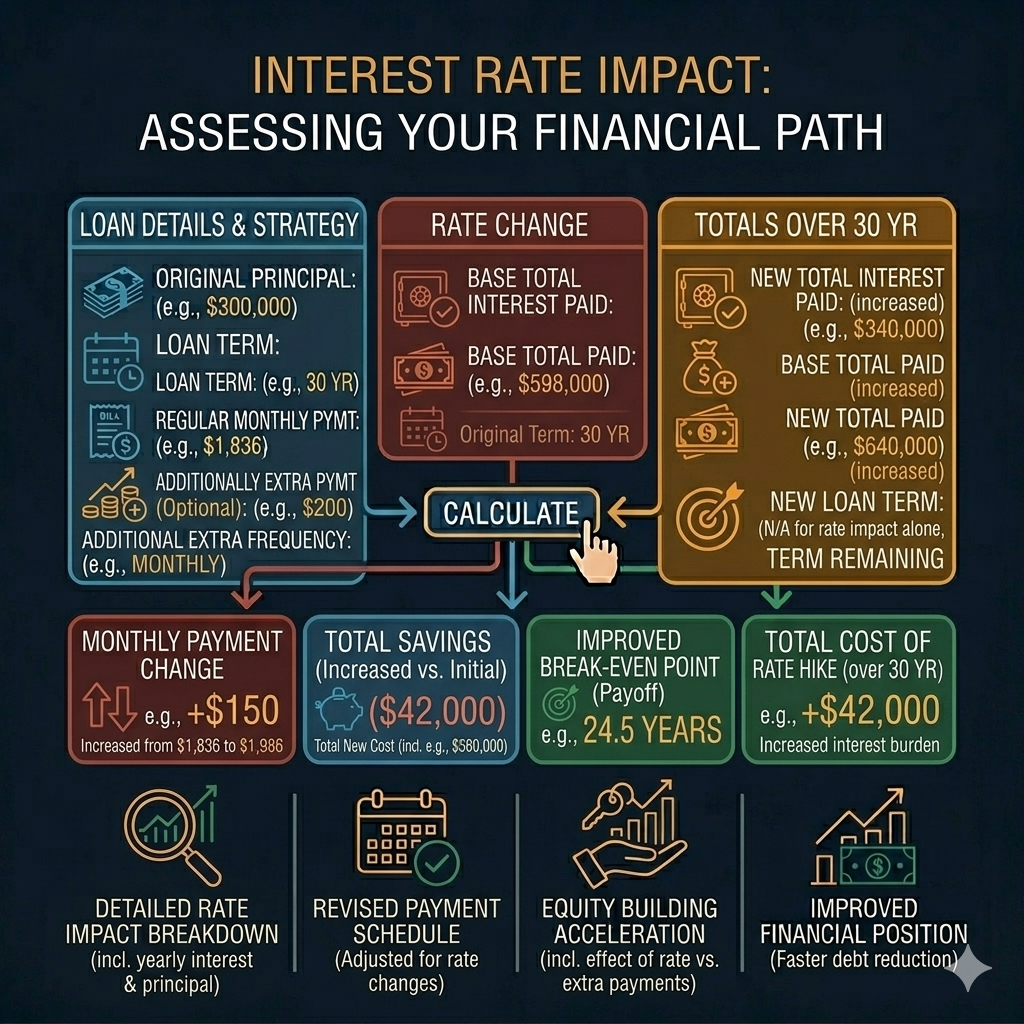
At 6.58%, total interest is $453,046. Each 0.25% rate increase adds roughly $21,000 to $23,000 in total interest.
| Rate | Monthly P&I | Total Interest | vs Base | Loan at Same Payment | Buying Power Change |
|---|---|---|---|---|---|
| 4.50% | $1,773.40 | $288,423 | -$457.29/mo | $440,250 | +$90,250 |
| 4.75% | $1,825.77 | $307,276 | -$404.92/mo | $427,623 | +$77,623 |
| 5.00% | $1,878.88 | $326,395 | -$351.81/mo | $415,535 | +$65,535 |
| 5.25% | $1,932.71 | $345,777 | -$297.97/mo | $403,960 | +$53,960 |
| 5.50% | $1,987.26 | $365,414 | -$243.42/mo | $392,872 | +$42,872 |
| 5.75% | $2,042.50 | $385,302 | -$188.18/mo | $382,246 | +$32,246 |
| 6.00% | $2,098.43 | $405,434 | -$132.26/mo | $372,059 | +$22,059 |
| 6.25% | $2,155.01 | $425,804 | -$75.67/mo | $362,290 | +$12,290 |
| 6.50% | $2,212.24 | $446,406 | -$18.45/mo | $352,918 | +$2,918 |
| 6.58% (base) | $2,230.68 | $453,046 | — | $350,000 | — |
| 6.75% | $2,270.09 | $467,234 | +$39.41/mo | $343,924 | -$6,076 |
| 7.00% | $2,328.56 | $488,281 | +$97.87/mo | $335,289 | -$14,711 |
| 7.25% | $2,387.62 | $509,542 | +$156.93/mo | $326,995 | -$23,005 |
| 7.50% | $2,447.25 | $531,010 | +$216.57/mo | $319,027 | -$30,973 |
| 7.75% | $2,507.44 | $552,679 | +$311,369 | -$38,631 | |
| 8.00% | $2,568.18 | $574,543 | +$337.49/mo | $304,005 | -$45,995 |
| 8.25% | $2,629.43 | $596,596 | +$398.75/mo | $296,923 | -$53,077 |
| 8.50% | $2,691.20 | $618,831 | +$460.51/mo | $290,109 | -$59,891 |
How Mortgage Rate Changes Affect Your Payment
Mortgage rates dictate how much money you pay each month for borrowing capital. On a 30-year fixed loan, even a quarter-percentage-point shift (0.25%) substantially changes your monthly obligation and total lifetime interest cost.
The Formula Behind the Table
Monthly principal and interest ($M$) is calculated using standard monthly compound amortization:
M = P × [ i(1 + i)^n ] / [ (1 + i)^n - 1 ]
where $P$ is the principal loan amount, $i$ is the monthly interest rate ($\text{annual rate} / 12 / 100$), and $n$ is the total number of monthly payments ($360$ months for a 30-year loan).
Why Small Rate Changes Compound Over 30 Years
Because mortgage interest is calculated against the remaining balance every month, higher interest rates slow down principal reduction during the first 15 years of the loan. For full monthly cost breakdowns including property taxes and insurance, use our comprehensive Mortgage Calculator.
Rate vs Buying Power
Purchasing power represents the total loan amount you can afford while maintaining a fixed target monthly payment. When mortgage rates rise, your purchasing power drops because a larger share of your monthly payment goes toward interest rather than paying down loan principal.
For example, if your housing budget supports a monthly P&I payment of $2,528, you can borrow $400,000 at a 6.50% rate. If rates rise 1.00% to 7.50%, that same $2,528 payment only supports a loan of roughly $361,500 — a loss of nearly $38,500 in purchasing power. Test your borrowing capacity using our Affordability Calculator.
Example Scenarios
The table below shows monthly P&I payments across standard loan amounts at 5.50%, 6.50%, and 7.50% interest rates:
| Loan Amount | 5.50% Rate | 6.50% Rate | 7.50% Rate | Monthly Difference per 1% Rate Shift |
|---|---|---|---|---|
| $300,000 | $1,703.37 | $1,896.20 | $2,097.64 | +$201.44 / mo |
| $400,000 | $2,271.16 | $2,528.27 | $2,796.86 | +$268.59 / mo |
| $500,000 | $2,838.95 | $3,160.34 | $3,496.07 | +$335.73 / mo |
The Cost of Waiting for a Lower Rate
Homebuyers often consider delaying a purchase in hopes that interest rates will drop. However, waiting carries distinct financial risks: home price appreciation during the waiting period can erode any potential rate savings, and ongoing rent payments represent unrecoverable housing expenses.
Buying Points vs Waiting for Rates to Fall
Discount points allow borrowers to pay upfront prepaid interest at closing to permanently lower their interest rate. Typically, 1 discount point costs 1% of the loan amount and lowers the interest rate by 0.25%. If rates later decline significantly, you can evaluate refinancing using our Refinance Calculator or compare multi-loan offers with our Loan Comparison Tool.
Common Mistakes to Avoid
- Interest Rate
- The annual percentage charged by the lender for borrowing principal balance, excluding fees.
- Annual Percentage Rate (APR)
- The broader annual cost of borrowing including interest rate, lender fees, origination charges, and prepaid points.
- Discount Points
- Upfront fees paid to the lender at closing in exchange for a lower note rate.
- Purchasing Power
- The maximum principal loan amount achievable at a given monthly payment ceiling.
- Rate Lock
- A guarantee from a lender holding a specific interest rate for a set period (typically 30–60 days) while your application is processed.
Frequently Asked Questions
How much does a 1% rate change affect my mortgage payment?
On a 30-year fixed loan, each 1 percentage point of rate changes the monthly payment by roughly 10% to 12%. For example, a $400,000 loan costs about $2,528 a month at 6.50% and about $2,796 a month at 7.50%, a difference of roughly $268 a month or more than $96,000 over the full term.
What is buying power and how do rates affect it?
Buying power is the loan amount you can borrow while keeping the same monthly payment. When rates rise, that fixed payment supports a smaller loan. A payment that finances $400,000 at 6.50% supports roughly $362,000 at 7.50%, so a one-point rate increase can reduce your purchasing power by close to 10%.
Does a 0.25% rate difference really matter?
Yes, though the monthly effect is modest, the lifetime effect is not. On a $400,000 30-year loan, 0.25 percentage points changes the payment by roughly $65 a month and total interest by more than $23,000. Whether that justifies paying discount points depends on how long you keep the loan.
Should I wait for rates to drop before buying?
Waiting can help if rates fall, but it carries risk because home prices, rent and competition may rise in the meantime. Many buyers weigh the cost of waiting against the option to refinance later if rates decline, since a rate can be changed after closing while a purchase price cannot.
Is it better to buy discount points or wait for a lower rate?
Buying points makes sense when you are confident you will keep the loan past the break-even month, which is usually somewhere between four and seven years. One point costs 1% of the loan amount and typically lowers the rate by about 0.125 to 0.25 percentage points. Compare the point cost, the monthly savings and your expected holding period before deciding.
Related Calculators
Explore our other mortgage decision tools:
- Mortgage Calculator — Estimate full monthly PITI payments.
- Affordability Calculator — Determine maximum purchase price based on income.
- Refinance Calculator — Calculate breakeven timing for rate reductions.
- Loan Comparison Tool — Compare side-by-side loan offers with different rates and points.
Sources & Methodology
Interest rate calculations use standard fixed-rate amortization formulas. Industry rate benchmark sources include:
- Freddie Mac Primary Mortgage Market Survey (PMMS) — Weekly national average benchmark rates.
- Consumer Financial Protection Bureau (CFPB) — Rate shopping guides and APR disclosure standards.
Last updated: July 2026. All calculations run client-side in your browser. MortiVio stores transient preferences using local browser storage (FormStorage).
Disclaimer
The results shown by this calculator are estimates for educational purposes only and are not a loan offer, a pre-approval, or financial advice. Actual payments depend on your lender, credit profile, property location, taxes, insurance, HOA dues, and loan program rules, and may differ from the figures shown here. Rates change daily. Consult a licensed mortgage professional before making a decision.
Last updated: .