Loan Comparison Calculator
This loan comparison calculator puts up to three mortgage offers side by side. Enter each loan's amount, rate, term, discount points and fees, and it returns the monthly payment, total interest, estimated APR and how long it takes for a lower rate bought with points to pay for itself.
Compare up to 3 loans side by side — monthly payment, total interest, estimated APR and payoff date. APR is solved from loan amount net of upfront points and fees for mathematical comparison.
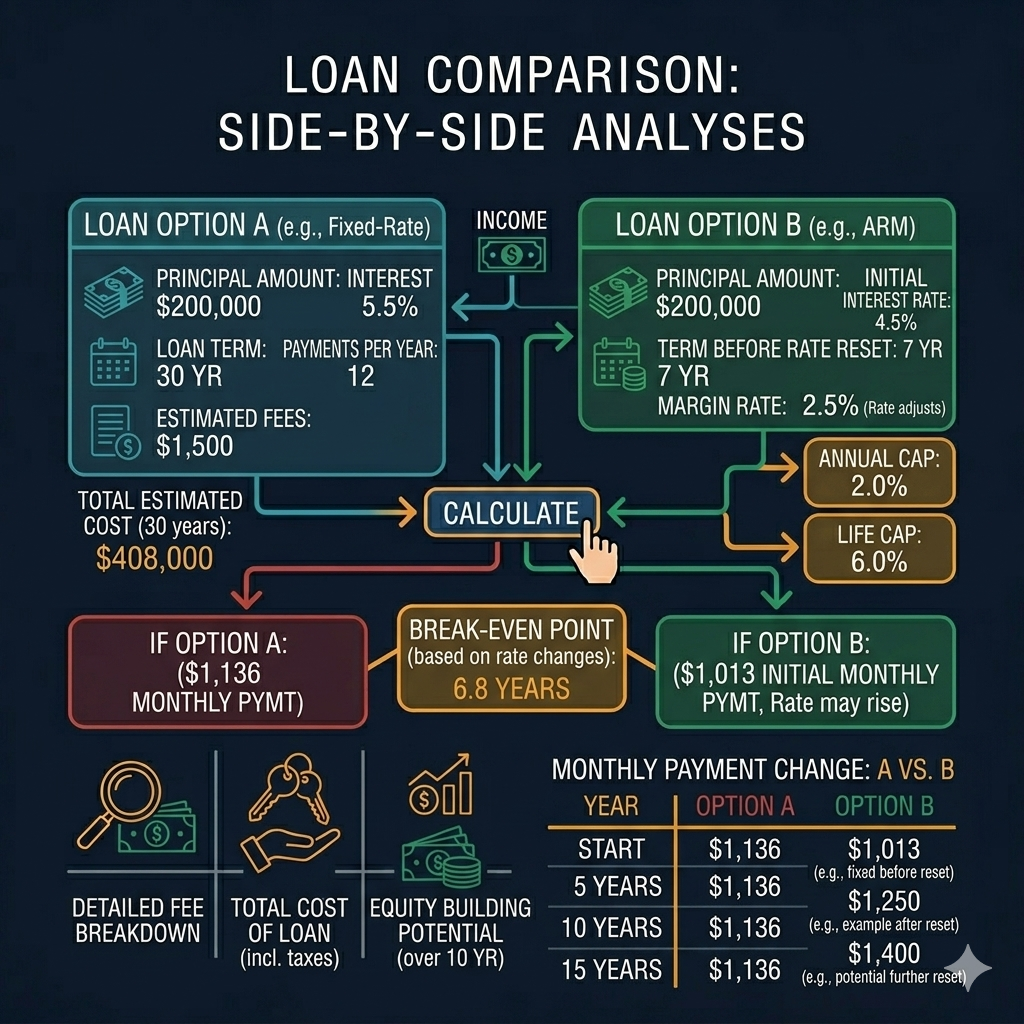
Loan Comparison Calculator
Compare Loans
| Parameter | Loan A | Loan B | Loan C |
|---|---|---|---|
| Loan Amount ($) | |||
| Interest Rate (%) | |||
| Loan Term | |||
| Discount Points ($) | |||
| Other Lender Fees ($) |
Results
| Metric | Loan A | Loan B | Loan C |
|---|---|---|---|
| Monthly P&I | $2,230.68 | $2,288.74 | $2,173.25 |
| Estimated APR | 6.663% | 7.015% | 6.608% |
| Total Interest | $453,046 | $473,945 | $432,371 |
| Total 30-Yr Cost | $806,046 | $830,445 | $792,371 |
| Cost Over First 5 Years | $464,779 | $472,679 | $467,386 |
| Points ($) | $0 | $3,500 | $7,000 |
| Other Fees ($) | $3,000 | $3,000 | $3,000 |
| Loan Term | 30 years | 30 years | 30 years |
| Payoff Date | Aug 2056 | Aug 2056 | Aug 2056 |
| Points Break-Even vs Base | Base offer | Never | 122 mo (~10yr 2mo) |
| Jumbo Status | No | No | No |
Loans above the 2026 conforming limit ($832,750) are flagged as Jumbo. Estimated APR reflects rate net of upfront points and fees.
Chart: total lifetime cost breakdown (Principal vs Interest vs Upfront Fees).
How This Loan Comparison Works
Mortgage quotes can be confusing because lenders package rates, discount points, and origination fees in different ways. A lower interest rate obtained by paying thousands of dollars in upfront points may actually cost more overall if you sell or refinance before reaching your break-even point.
Rate vs APR: Which Number Should You Compare?
Your interest rate determines your required monthly principal and interest payment. The Annual Percentage Rate (APR) expresses the effective annual cost of credit by spreading upfront points and lender fees across the loan term.
Estimated APR is solved by finding the internal rate where PV(monthly P&I) = Net Disbursed Principal
While APR provides a standardized baseline, it assumes you keep the loan for its full 30-year term. If you move or refinance in 5 to 7 years, comparing your 5-year total cost and points break-even month is far more informative.
Discount Points: When Buying Down the Rate Pays Off
One discount point costs 1% of the loan amount ($3,500 on a $350,000 mortgage) and typically lowers the interest rate by 0.25 percentage points (25 basis points). To determine whether buying points is worthwhile, calculate how many months of payment savings are needed to recover your upfront cash:
Break-Even Months = Upfront Points & Fees Difference / Monthly Payment Savings
Example Scenarios
Example: Three $350,000 loan offers over 30 years with $3,000 in standard fees:
- Loan A (Zero Points): 6.58% rate, $0 points → $2,230.68/mo P&I, 6.663% APR. 5-year cost: $464,779.
- Loan B (Higher Rate + Points): 6.83% rate, $3,500 points → $2,288.74/mo P&I, 7.015% APR. Dominated offer (never breaks even).
- Loan C (Lower Rate + $7,000 Points): 6.33% rate, $7,000 points → $2,173.25/mo P&I, 6.608% APR. Saves $57.43/mo vs Loan A, breaking even at month 122 (~10 years 2 months).
Three Sample Offers Compared ($350,000 Loan Amount, 30-Year Term)
| Loan Offer | Interest Rate | Points Paid ($) | Monthly P&I | Estimated APR | 5-Year Total Cost | Break-Even vs Base (Loan A) |
|---|---|---|---|---|---|---|
| Loan A (Zero Points) | 6.58% | $0 | $2,230.68 | 6.663% | $464,779 | Base offer |
| Loan B (Rate Increase + Fee) | 6.83% | $3,500 | $2,288.74 | 7.015% | $472,679 | Never (Costs more) |
| Loan C (Rate Buy Down) | 6.33% | $7,000 | $2,173.25 | 6.608% | $467,386 | 122 months (~10.2 yrs) |
What One Discount Point Does ($350,000 Loan Baseline)
| Discount Point Cost | Typical Rate Reduction | Monthly Payment Savings | Average Months to Break Even |
|---|---|---|---|
| 1.00 Point ($3,500) | -0.25% (e.g. 6.58% → 6.33%) | ~$57.43 / mo | ~61 months (~5.1 years) |
| 2.00 Points ($7,000) | -0.50% (e.g. 6.58% → 6.08%) | ~$113.80 / mo | ~62 months (~5.2 years) |
Loan Estimate Sections and Negotiability
| Loan Estimate Section | Fee Examples | Negotiable or Shoppable? |
|---|---|---|
| Section A: Origination Charges | Points, processing fee, underwriting fee, application fee | Yes — Negotiable directly with lender |
| Section B: Services You Cannot Shop For | Appraisal, credit report, tax service, flood certification | No — Set by lender third-party vendors |
| Section C: Services You Can Shop For | Title insurance, settlement agent fee, survey fee | Yes — You can select your own title company |
| Section E & F: Taxes & Prepaids | Government recording fees, transfer tax, prepaid hazard insurance | No — Set by local government and insurance provider |
Assumptions and Limitations
- APR values calculated by this tool are estimated for comparison purposes and may differ slightly from official lender Loan Estimate disclosures.
- Calculations assume fixed-rate loans. Adjustable-rate mortgages (ARMs) have variable future payments not modeled here.
Frequently Asked Questions
What is the difference between interest rate and APR?
The interest rate determines your monthly principal and interest payment. The APR spreads the rate plus points and most lender fees across the life of the loan, so it is a broader cost measure. A loan with a 6.33% rate and $7,000 in points can carry a higher APR than a 6.58% loan with no points. Compare the rate for the payment and the APR for total cost, then check the break-even if you may move early.
Are mortgage points worth buying?
One point costs 1% of the loan amount and typically lowers the rate by about 0.25 percentage points, though the exact trade varies by lender. On a $350,000 loan, one point costs $3,500 and saves roughly $55 to $60 per month, breaking even in about five years. Points pay off if you keep the loan past the break-even point and still have cash left after your down payment and reserves.
Why does the lowest rate not always mean the lowest cost?
Because lenders can buy the rate down with points and add origination, underwriting and processing fees that never appear in the rate. A quarter point of rate on a $350,000 loan is worth about $55 a month, while $4,000 of extra fees is paid on day one. Comparing monthly payment, APR and total upfront cost together prevents a cheap-looking rate from hiding an expensive loan.
How many lenders should I get quotes from?
Three to five quotes gathered in the same short window is a practical target, and many borrowers still get only one. Rate shopping within a 14 to 45 day period, depending on the scoring model, counts as a single credit inquiry, so comparing lenders does not repeatedly hurt your score. Ask each lender for a Loan Estimate on the same day for the same loan amount and term so the comparison is fair.
Which mortgage fees can I negotiate?
Lender-controlled charges such as origination, underwriting, processing and application fees are usually negotiable, and title services can often be shopped separately. Items you cannot change include recording fees, transfer taxes and prepaid escrow deposits. Sections A and C of the Loan Estimate show which is which, and a competing written offer is the strongest lever you have.
Related Calculators
Explore our related loan evaluation tools:
- Mortgage Calculator — Detailed monthly payment breakdown.
- Refinance Calculator — Compare current loan vs refinancing offers.
- Affordability Calculator — Income and DTI budget ceiling.
- DTI Calculator — Evaluate debt-to-income limits.
Sources & Methodology
Comparison standards follow official Consumer Financial Protection Bureau guidelines:
- CFPB Loan Estimate Explainer — Official guide to understanding mortgage disclosures.
- FHFA Conforming Loan Limits (2026) — National conforming loan thresholds.
Last updated: July 2026. All calculations run client-side in your browser. MortiVio stores transient preferences using local browser storage (FormStorage).
Disclaimer
The results shown by this calculator are estimates for educational purposes only and are not a loan offer, a pre-approval, or financial advice. Estimated APRs are calculated for comparison and may differ from official lender Loan Estimate disclosures. Rates change daily. Consult a licensed mortgage professional before making a decision.
Last updated: .